

Leslie Goodwin, Merchant Marine, age 17
My wife, Virginia, taught German in high school. We took our students to San Francisco and made contact with a German company that sailed freighters. There was a captain there who gave our students a tour of his ship.
The captain came and talked to me 鈥� he had actually been a U-boat captain in the war. He told me, 鈥淏ack in those days, we tried to kill you; you tried to kill us. But now the war is over, and we are friends.鈥� And that was their attitude. They got drafted; we got drafted. We all had our jobs to do.
鈥� Leslie Goodwin
My life has been blessed with five miracles, and they all took place during World War II. What was I doing as a child and as a young man to have so many miracles in my short life? Well, I鈥檒l tell you.

Leslie, his grandfather James Jones, and twin brother Norman, circa 1929
In the Beginning
My wartime story actually began when I was 11 years old, and the year was 1938. In 1924, three years before my birth, my family emigrated to the U.S. from Lancashire, England and settled in San Francisco. My mother鈥檚 father eventually became homesick for England and wanted to go back. My father told the family that he would be the first to go, and that he would get a job and see if things were safe enough for everyone to follow.
After Dad was back in England, he sent word back to us not to come, because war seemed to be imminent. But we鈥檇 already bought the tickets to go, so we went anyway.
When Dad sailed over, he had a Swedish roommate on board who was not well, and he was going back to Sweden to die. But the fellow never made it to Sweden; he died aboard the ship. The captain had never held a funeral in all his 35 years of sailing, but Dad, being a devout Christian, was comfortable arranging the whole service. Dad sang as well. The captain was very happy that my father was able to provide that service for the gentleman who had passed away.
Voyage to England
It took six weeks for the rest of the family to sail on the Annie Johnson from San Francisco through the Panama Canal and on to reach England. The Annie Johnson was a passenger cargo ship that carried 60 passengers and could only go 12 knots, but we loved it.
My identical twin brother, Norman, and I turned 11 during the voyage. I loved being an identical twin. If you鈥檙e a twin, you live a lifestyle others know nothing about.
In our family, there are 15 sets of twins. I grew up and married Virginia, and in her family, there are 35 sets of twins! Two of our children are in fact twins.
Our ship鈥檚 captain, as it turned out, was the very same captain who had carried Dad on his voyage to England. My mother showed the captain a picture of the Swedish man鈥檚 burial at sea. The Captain was glad to meet her and right away asked, 鈥淲here are the twins?鈥� He then gave Norman his captain鈥檚 hat. I don鈥檛 know why he gave it to Norman and not to me!
The captain had liked my dad very much, and he assigned one of his officers to sit next to my young mother at all meals for protection from any men on the ship. They were really good to us.
While on that trip, our ship was caught in a hurricane in the Caribbean. It was during the hurricane that Norman and I celebrated our 11th birthdays on board. Even though we were navigating through a bad storm, the ship鈥檚 cook baked us a three-tiered birthday cake 鈥� chocolate, strawberry, and vanilla.
Being in a hurricane, most of the adults were seasick. But our family is descended from a long line of English sea captains on one side and English chaplains on the other, so we don鈥檛 get seasick.
Norman and I, along with four other children on board, ate our cake and enjoyed it very much.
School in England
When we arrived in England, all the newspaper headlines said that the country could be at war tomorrow, as it was the middle of the Munich Crisis. This was 1938. But the war didn鈥檛 happen quite that soon.
We settled in a town called Romford, in Essex. It鈥檚 about half an hour by train east of London, but it鈥檚 still all part of Greater London.
My brother and I went to school there, and the school had what they called grades A, B, C and D, with the highest achievers in grade A and the lowest in Grade D. We took the placement test and flunked the math portion because we didn鈥檛 know the English monetary system of pounds, shillings and pence. So they put us in Grade D.
My father had purchased books on English history and English geography, and we鈥檇 been reading them and other books all the way across the ocean. When it came time for us to take those tests, Norman and I got the top scores, and the teacher was absolutely furious.
In that school, the boys were usually on the main floor and the girls had to climb the stairs to go up. If there were classes with boys and girls together, the boys took the seats by the windows, and the girls took the seats by the wall.
The teacher was so furious with Norman鈥檚 and my high scores that he made all the boys stand up, and then he said that all the boys had to go sit with the girls because Norman and I had beaten them. Norman and I were the first boys to obey the teacher and get up from our seats.
Because we were up first, we looked around the class for the prettiest girls and got to sit next to them. In England, the class system 鈥� and this included the place women occupied in society 鈥� was part of school life from grade school on.
War is Declared
We had a great time meeting all of our English relatives. After a year, though, it was time to return to the U.S. But war had broken out 鈥� Germany invaded Poland on September 1, 1939. England declared war at 11:15 am on September 3, and France declared war at 5 that afternoon.
We booked passage on a ship to leave England, but on the way to England, the ship that was to take us home was torpedoed by the Germans and sank. So we booked passage on another ship, and that ship was torpedoed as well. At that point, we were told that it wouldn鈥檛 be possible to return to the United States. Our adopted country was now at war and we were stuck. Norman and I were 12 years old.
My grandfather was still back in the U.S. He was a wonderful man and was really the one who had wanted to go back to England in the first place. But my father was the first to return to England, to secure a job and find a place for us all to live. My grandfather couldn鈥檛 get back to England because the war was now on, and he died in the U.S. without ever again seeing home.
First Miracle
My family was living outside London, and we were being bombed night and day. At one point, we were bombed 76 days and nights in a row. The planes would go home for lunch, and we would have just enough time to come up, grab a really quick lunch and then go back down into the shelter. We were living in house number 73 on our street.
There was a man from Scotland in house number 4. That man couldn鈥檛 take the bombing any more and went back home to Scotland. My mother wanted a bigger house, and even though number 4 was near a Royal Air Force Fighter command base, we moved into it.
About a week later, German planes were coming in to bomb, and the British gunners were firing back at them. Some of the anti-aircraft shells went right into my old bedroom window in our old house. If the bombing had happened a week earlier, I would have been killed right in my bedroom.
To calm our fears, my father read us the 91st Psalm every night during the bombing:
鈥淗e that dwelleth in the secret place of the Most High shall abide under the shadow of the Almighty. I will say of the Lord, He is my refuge and my fortress: my God; in him will I trust . . . He shall call upon me, and I will answer him; I will be with him in trouble; I will deliver him, and honor him. With long life will I satisfy him, and show him my salvation.鈥� Those words gave us great comfort.
Second Miracle
Every family had its own air raid shelter. Ours was six feet long and built three feet into the ground that we had dug out ourselves. It was dark inside, and we used flashlights to see.
My mother found a home in the country and wanted to move there because she thought our family would be safer. She asked the authorities if we could move into that house, but a larger family with five children was given the house instead, so Mother found a different one for us.
A week after we had moved into our new house, we were again bombed. This included the area where the house that my mother had originally wanted was 鈥� the house that had been given to the other family instead of us. A bomb intended for that family鈥檚 house missed, and instead, exploded on their air raid shelter, killing the entire family of seven.
Our family moved back closer to Dagenham, a London suburb on the River Thames.
Third Miracle
In the new house we lived in, bombs were being dropped nearby, but instead of landing in the River Thames, they dropped on the land. The houses were back to back. We had to evacuate, so we went to the railway station. There we found an empty house with an air raid shelter, and we went down into it. Instead of the bombs hitting all at once, they were being dropped one by one in a row, and each one was getting closer to us.
As the bombs came closer and closer, we thought, boy, this is going to be it. My mother started screaming, and that was the only time I ever saw my father hit my mother. He immediately brought her close to him and held her for comfort. But the bomb intended for us came down and hit on the other side of the house, missing us. We were safe.
Norman and I graduated from school on a Friday in 1940 at 13 years of age. Because England had the class system and our family was working class, we were expected to go to work in a factory. So the following Monday, we reported for work. Those in the upper class automatically continued school. And if your family was in banking or had money, you could also go on. But my folks only had eight grades of education 鈥� my father was a machinist and my mother was a welder.
My father was working for Ford Motor Company in England, but in the war they were making mostly military trucks and tanks. Norman and I started working for the Briggs Motor Company. We were making the motors to go into the tanks and cars. At some point, Norman got a job in the accounting office, and I got a job in the engineering office. I became a junior draftsman and was eventually put in charge. I was taking old drawings and re-doing them, copying them from drawings that were fading.
Seeing Glenn Miller鈥檚 Last Performance
When we were 16, Norman and I went into London on Sundays to work for the USO. The USO was at Piccadilly Circus, and we had to take the train to get there. At that point, we were helping U.S. servicemen.
My boss was Fred Astaire鈥檚 sister, Adele Astaire-Cavendish. She had married an English Lord, and was Lady Cavendish at the time. He was younger than Adele and died during the war. Instead of coming back to America, she stayed on in England to work for the servicemen. I was working at the same place, helping guys on leave find places to stay and doing other odd jobs like that.
One day Adele said to me, 鈥淚 am taking you and your brother to Harrow School and Oxford University.鈥�
When she was showing us around Harrow, she said, 鈥淚 have something over here I want to show you.鈥� And she took us over to a school desk that had the name Winston Churchill carved into it. Churchill had carved it when he was a boy going to school there in the 1880s.
Another night Adele said, 鈥淵ou鈥檙e not going home early tonight. You can be my date at the dance.鈥� Well, I didn鈥檛 know how to dance. I鈥檓 guessing she was maybe in her 40s, and I was only 16. But it was OK; we were only friends anyway. We got to the dance and when we went inside, it was jam-packed. It was too crowded to dance, so all we could do was sway to the music. It was then that we found out the band was Glenn Miller鈥檚.
After the show that evening, Miller put his instruments together and got on a small plane headed to Paris. The band was going to follow later. Miller鈥檚 airplane disappeared somewhere over the English Channel, and he died that night. One rumor was that the Royal Air Force had shot him down, but of course in England, they did not let that story get out. The airplane鈥檚 pilot was a new pilot, and perhaps he just happened to be in the wrong place at the wrong time.
Nothing was ever said about the disappearance because the American servicemen would have gone berserk. Needless to say, I am thrilled that I got to go with Fred Astaire鈥檚 sister, and I got to see Glenn Miller in person the last night he ever played. I did not learn until after the war was over how he might have been killed.
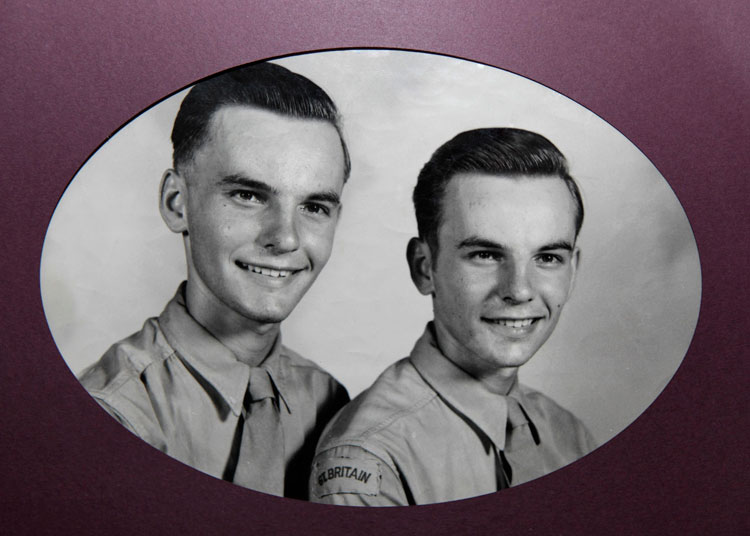
Norman and Leslie Goodwin
Enlist or Be Drafted
We were 12 when the war started, and when we were 16, Norman and I were a year away from being eligible for England鈥檚 draft. We were Americans, and in the U.S., we held dual citizenship. But in the eyes of England, we were English and English only. They would put us in the British Army as soon as we turned 17.
We had tried to register as American citizens born in San Francisco of English parents. But the English would not recognize that. We were told that if a cat has kittens in a pigpen, they are still kittens and not pigs. And they would not recognize us as Americans.
So we went to the American Embassy and asked them what we could do. The Embassy told us to join the U.S. Merchant Marine. They told us not to say anything to anybody, and that they would send for us.
We went back to work at the factory. By and by, we got a telegram saying that our ship was waiting for us in Plymouth, England, and to report to it in the morning. We reported for work as usual in the morning, but told everyone we鈥檇 be leaving. They said, 鈥淵ou can鈥檛 do that!鈥� and we said, 鈥淭a-ta, we鈥檙e leaving!鈥� We got on the train, went to the ship and sailed away.
We were just 16 when we joined the Merchant Marine, but by the time we got the call, we were 17.
I weighed just 112 pounds. We hadn鈥檛 had enough food to eat. After the war, Churchill said that twice England had gotten down to seven days of food left for his country to eat. If the Americans and Canadians had not sent food over, England would have either starved to death or been forced to surrender.
Time in the Merchant Marine
In 1944 Norman and I were on an ocean-going salvage tug in a slow convoy bringing damaged U.S. ships back to America for repair. The Germans had sent three U-boats from Norway to patrol the coast of Greenland. They were sending weather reports back to Germany.
German U-boats had often been used earlier in the war to target merchant convoys bringing food and supplies from Canada, the British Empire and the United States to Great Britain. It was an effective way of cutting off food supplies to the British.
Fourth Miracle
When those three U-boats had finished sending their weather reports, they were released to patrol for enemy shipping. Well, U-870 sighted our convoy of ships 380 miles north of the Azores, and it attacked us.
Usually a torpedo just goes straight. But the torpedoes on those U-boats were different. The first torpedo that was fired would come to the surface, then drop, come to the surface, drop, surface, drop鈥� My brother and another young man were on top of the ship, and I was down in the hold getting supplies.
The two up top saw the torpedo coming, and I of course didn鈥檛 see it, but they gave the alarm.
The young man asked Norman to teach him how to pray. Norman replied, 鈥淚f you don鈥檛 already know how to pray, it鈥檚 too late for you, son!鈥� So the fellow dropped to his knees and prayed the only prayer he knew: 鈥淣ow I lay me down to sleep . . .鈥� Norman cried out, 鈥淔ather, don鈥檛 listen to him! I don鈥檛 want to go to sleep!鈥�
Norman had no sooner said that than the torpedo went under our ship, up the other side, and hit the ship beside us, killing two men.
We had four destroyer escorts and one of the destroyers, the U.S.S. Fogg, came racing back to get the U-boat. The second torpedo hit the Fogg, and it was not defective. It was a torpedo that homed in on the sound of the engines. Boom 鈥� it hit, and one third of the destroyer was hanging dead in the water.
They got a Navy tug to tow the Fogg, but with a third of it underwater, the tug and the ship were veering all over the ocean. Two days later, the part of the ship that was underwater fell off, and they were able to get it into the Azores for repair.
After those two torpedo hits, U-870 took off and attacked two British convoys near Gibraltar. We kept on going, but we got into hurricane-force winds. So in one day, sailing for 24 hours, we made only 37 miles. That鈥檚 all. It took us 31 days to go from England to America.

Ernst Heckler aboard U-870, 1943 or 1944
Interestingly enough, when I was in college after the war, I was working on my master鈥檚 degree in maritime history. I wrote to the German Navy and found out that it was U-870 that fired the torpedo at us.
They gave me the address of the commanding officer, whose name was Heckler. I wrote to Heckler in Germany and sent a picture of myself and a picture of my ship.
I got an answer back from Heckler鈥檚 son in three weeks, along with a picture of his father鈥檚 U-boat. Heckler had already died, but his son was very pleased to correspond with me.
Heckler鈥檚 picture shows him backing out of the harbor with him on deck, and they are hoisting the Nazi flag. Heckler is saluting, but he鈥檚 not giving the Heil Hitler salute. He鈥檚 saluting the Navy way. He had originally been in the air force, but they took him out of the air force and put him into the navy because it was more important to sink our ships.
Heckler鈥檚 son was a professional navy guy, and he said, 鈥淚 wish you would have written me last year. I was in San Francisco, and I could have come to see you. The next time you and your wife come to Germany, you come to see me and stay in my house.鈥�
My wife, Virginia, taught German in high school. We took our students to San Francisco and made contact with a German company that sailed freighters. There was a captain there who gave our students a tour of his ship. The captain came and talked to me 鈥� he had actually been a U-boat captain in the war.
He told me, 鈥淏ack in those days, we tried to kill you; you tried to kill us. But now the war is over, and we are friends.鈥� And that was their attitude. They got drafted; we got drafted. We all had our jobs to do.
Back to the War
Two days after that torpedo attack, a 500-pound hatch cover fell on top of my foot. I was coming out of a hold, and we were in heavy seas. The ship lurched, I slipped and went underneath the hatch cover, and that鈥檚 when it came down on me, landing on my left big toe. The bone was hanging down, and it was sticking out. I got a bone infection from it, but it did not cause a permanent injury.
I couldn鈥檛 walk for some time after that injury, so I was lying on my top bunk. I didn鈥檛 get seasick, so I usually chose the top bunk, thereby avoiding finding myself below someone who might be ill above me.
There was yet another U-boat attack. The bells were ringing, everybody was running, and I couldn鈥檛 move. I鈥檇 seen too many movies of ships going down that way and the men drowning.
I didn鈥檛 want to go that way, so I rolled out of the bunk hoping to land on my good leg, and I did. But I couldn鈥檛 walk, so I had to crawl all the way up the passageway and up the ladder to where the lifeboats were.
By the time I got there, the attack was over, and I had to be carried back to my bunk.
Back in the U.S.
Two weeks later, I was in my bunk, and a big sailor came and picked me up out of the bunk and said, 鈥淗ere, I鈥檝e got something to show you.鈥� He carried me outside, and there was the Statue of Liberty. The fellow carrying me had a son whom he had never seen鈥攈e was born while the sailor was aboard ship. Norman and I had been away from the U.S. for seven years, so we were very happy to be back home again.
I was in the Marine hospital on Staten Island for 2 陆 weeks. When I was able to walk again, Norman and I went to stay with relatives in Youngstown, Ohio. Because we were only 17 and in America, we were no longer obligated to the Merchant Marine.
I stayed at my aunt and uncle鈥檚 house in Youngstown. The lady next door belonged to the same church as Norman and I, so she would take us to church, and another lady would take us home for dinner. The father in that home was very angry because his son had been drafted into the medical corps when he was 18 years old and was sent overseas. He hadn鈥檛 been over there very long at all when his parents got a message that he鈥檇 been killed in action.
Their son鈥檚 name was Bruce Robbins. His father was angry at God and said, 鈥淕od, if you鈥檙e going to kill somebody, kill me. But don鈥檛 kill my son.鈥� He鈥檇 been the head elder in the church, but after his son was killed he gave up going to church. Well, what could I say? Here we were in uniform 鈥� I was wounded, but I was still alive.
Drafted into the U.S. Army 鈥� the Fifth Miracle
When I was able to walk again without crutches, Norman and I were drafted into the U.S. Army.
This was in 1945, when I was 18. Norman and I became surgical technicians, and we were shipped to Camp Polk, Louisiana. Brothers were by then not allowed to serve on the same ship or in the same unit, sparing families the chance of losing two sons at once. But separating twins can be pretty rough on them, so we were always allowed to serve together.
There we were, identical twins serving together in the same hospital. One day a patient requested Norman to get him a bedpan, so Norman went to get it.
Then I walked into the room and the patient said, 鈥淲here鈥檚 my bed pan?鈥� I said, 鈥淵ou didn鈥檛 ask me to get you a bed pan.鈥� 鈥淵es I did!鈥� Oh, he got so angry.
My brother then came into the room with the bedpan, and by then the patient was so angry that he said, 鈥淣ow I don鈥檛 want it!鈥�
The nurse who saw all this said, 鈥淲e can鈥檛 have you twins on the same ward anymore.鈥� And they moved Norman to another floor.
In that other ward Norman was told to give a patient a blood transfusion, which he had never given before. We鈥檇 practiced, but we鈥檇 never done it. So this guy started cussing and swearing, saying, 鈥淵ou @$# &*#@ pill roller. You鈥檙e not going to practice on me!鈥�
The nurse heard all the yelling and came running over, saying, 鈥淗e鈥檚 given thousands of these.鈥� Well, she was lying, but while they were arguing, my brother went over and gave the transfusion to him.
All the commotion woke up a sergeant in the next bed who pulled himself up on the bar and said, 鈥淒on鈥檛 you call him a $#@ &)*% pill roller! That鈥檚 not what he is. Let me tell you a story about two pill rollers.鈥�
He then began his story.
鈥淚 landed with my men on the beach in Normandy. We got through the first day 鈥� a day of hell. We got through days two, three and four, and then crossing a field, the Germans opened up on us with machine guns. I鈥檓 wounded and I鈥檓 bleeding to death. An officer called for a volunteer. Two guys stepped up, and they were both Saturday boys. (One was a Jew, and one was a Seventh Day Adventist, like me.)
鈥淭he Adventist volunteered first. He took me under the arm and pulled me back. We could hear an 88mm shell coming at us. He covered my whole body with his, and he took the explosion and was killed. So now I鈥檓 bleeding to death under a dead body, and then the Jew came and took the Adventist off and got me to safety. Then they returned and retrieved the Adventist鈥檚 body. That Adventist had saved three lives already that day.鈥�
My brother said, 鈥淒o you know the name of the Adventist?鈥�
And the sergeant replied, 鈥淵eah. His name was Bruce Robbins, and he was from Youngstown, Ohio.鈥�
Helping a Father to Forgive
Well, Norman and I were happy that this story had come out, and we wanted to tell Bruce鈥檚 father back in Youngstown about it. The next time we went home to Youngstown on leave, we went to Bruce鈥檚 folks鈥� house for dinner.
We waited until after dinner when everybody was done eating. Then Norman said, 鈥淒o you want to know how your son was killed?鈥� And Norman told the story.
When Mr. Robbins realized his son had given his life to save that sergeant, the Holy Spirit hit him between the eyes. God had given his son to save Mr. Robbins鈥� life, and that鈥檚 when the fellow broke down and cried, and he came back to God.
When you put it all together, a number of events had to line up for this story to even get to Bruce鈥檚 father.
When I was still aboard the Merchant ship, if that defective torpedo had struck our ship and killed me, I never would have gone to Youngstown and met Bruce Robbins鈥� father. And if I had been killed, Norman and I never would have gone to Camp Polk together as twins.
Well, years later I was at the University of Connecticut studying maritime history. I got off the train in Youngstown, Ohio, and spent a day with Mr. Robbins. At the end of the day, Mr. Robbins took me back to the train station and said, 鈥淚鈥檓 an old man now, and I鈥檒l probably never see you again on this earth. But if I don鈥檛, I鈥檒l see you in Heaven.鈥�
In other words, he鈥檇 forgiven God. What young Bruce hadn鈥檛 known was that when he鈥檇 given his life to save the sergeant, he鈥檇 saved his father too. And on the resurrection morning when they all come up, that鈥檚 going to be quite a reunion. His father will be able to tell him what happened.
My brother and I were thrilled that all of this had taken place. If the bedpan incident had never happened, and if that guy hadn鈥檛 been doing all his screaming and yelling, Bruce鈥檚 father never would have heard that story. And that鈥檚 amazing.
I heard an Adventist say that there is never any accidental meeting of people, and that God put them there for a reason.
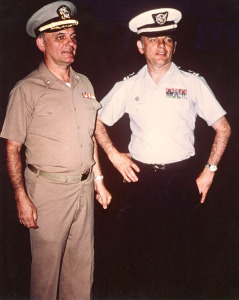
Norman and Leslie aboard the USS Tarawa
Life after the War
I went to City College in San Francisco on the GI Bill. I then transferred to Pacific Union College (PUC), an Adventist school in Angwin, CA. That is where in 1948 I met my wife, Virginia, and we were married in 1950.
Norman and I started out in pre-med because our parents wanted us both to be doctors. But then I enrolled in a history class, and I loved it, so I switched majors. About that time I was teaching the junior division in church. People at church asked about my college classes. When I told them what I was taking, they said I was a born teacher, and suggested teaching is what I should do. So I changed my major to history and trained to become a teacher.
Norman stayed one year longer in pre-med, but he wanted to be a Navy chaplain. So Norman changed his major to theology.
My first teaching jobs took me to Texas for five years. Texas is where Virginia and I had our children, including our twins, who, like Norman and me, were born seven minutes apart. Later I was offered a teaching position at an Adventist school here in California, Armona Union Academy in Kings County. I taught at Armona for five years, and then
I was offered a job at Monterey Bay Academy. I taught at MBA for 32 years, so my total years of teaching were 42.
When I retired, my paycheck had reached $30,000 a year. That was it. The public school teachers got far more, but I enjoyed teaching where I was, and I have absolutely no regrets. Not only did I teach history, but I also taught Bible and current events.
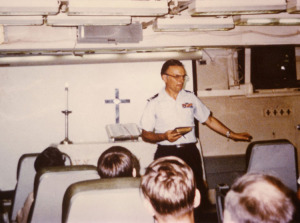
Leslie preaching aboard the USS Tarawa
I got my master鈥檚 degree in history from PUC, but, because I was teaching at the time, it took me seven summers to get it. That was the only time of the year I had time to take classes.
I had an education professor who was from England, and he told me that I should take my master鈥檚 in the teaching of history. He wanted me to work in the education department, but I told him that I wanted to take it in pure history. So he told me that he would make sure I鈥檇 flunk my orals.
Well, the history professor didn鈥檛 see things that way. He said he鈥檇 make sure the education professor was gone when I took my orals. The education professor happened to be overseas somewhere when it was time to take my orals, so that was good.
My thesis was on German U-boats, and I had to orally defend it in front of a board. This was duck soup because I鈥檇 already written my thesis. But the board would be able to ask me any question on any summer class I鈥檇 taken over seven summers. That鈥檚 when it got rough. Of all the people taking their orals that day, three were for history.
The other two candidates did not write a thesis and took extra classes instead. The first one flunked his orals. When the second candidate got wind of that, he decided to make up answers. And he flunked. I was the third to go in. They told me, 鈥淚f you make it, we鈥檒l come and shake your hand.鈥�
Afterward they all came over and shook my hand. The other two candidates had to take more classes. They should have written a thesis.
I took additional post-graduate work in maritime history at the University of California in Berkeley, but I hated it there. Everybody in the class was a fellow teacher, and each class had 250 students.
The classes were way too big, so I transferred to Stanford. They had smaller classes, and that school was a lot of fun. But I didn鈥檛 complete the work. I realized that at my age, if I earned my doctorate, Monterey Bay Academy might not be able to afford to have me. I also took postgraduate classes at the University of Connecticut.
The children Virginia and I have are twins 鈥� Paul, who is an attorney down in Southern California, and Pam, who retired from the Loma Linda Academy as principal of their high school section.
Pam currently works here in Sonora as the secretary at the Adventist Church. We also had a daughter, Sylvia, who was killed in an automobile accident in 1973.

Leslie and Norman aboard the USS Tripoli
Coast Guard Auxiliary
The most important part of my story is that because of my 42 years of high school teaching and my knowledge of maritime history, I have been a member of the United States Naval Institute for more than 50 years.
I have also been a member of the Coast Guard Auxiliary for more than 50 years. There is no upper age limit, and there is no pay. Why is this important? Because our mission is to go out and to save lives. I joined the Coast Guard Auxiliary because it is a lifesaving institution.
I am often asked to speak to high school students, and I tell those who want to go into the military about the rewards of being in the Auxiliary. As a teacher, I also enjoy giving talks to student groups about my life experiences.
A young man once said to me, 鈥淚 want to be a fighter pilot in the Navy.鈥� I said to him, 鈥淲hen Jesus comes and asks what you have done, would you rather say, 鈥業 shot down six enemy aircraft,鈥� or would you rather say, 鈥業 saved 300 lives鈥�?鈥�
I told him, 鈥淭he Army, the Navy, the Air Force, and the Marines all have guns and hope they don鈥檛 have to kill. Well, the Coast Guard has guns, too, but our primary job is saving lives. Think about that.鈥�
That young man decided to go into the Coast Guard; the Lord changed his course that day.
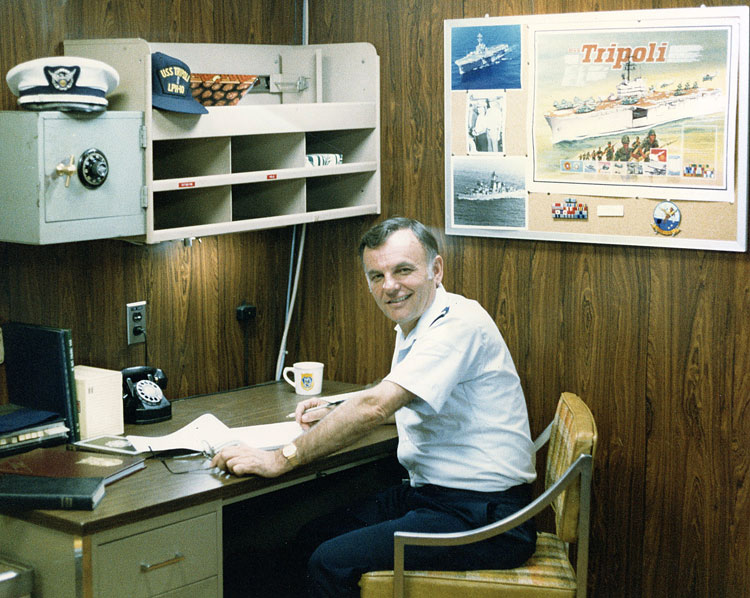
Leslie鈥檚 cabin aboard the USS Tripoli
My Coast Guard unit in Santa Cruz is small, but we saved 99 lives one afternoon. That day they had a big yacht race, and the people racing decided they were going to race without life jackets. They thought the jackets would be too cumbersome. Thirty-six yachts were in the race, and 33 of them tipped over. There were 99 people in the water without life jackets, and our unit went out and saved them all.
Final Thoughts
I鈥檝e had five miracles in my life:
1) Narrowly missing the British anti-aircraft shells hitting my bedroom in house number 73
2) Not being allowed to move into the house my mother wanted and missing the attack that took place there
3) Surviving the bombing with my family near the River Thames
4) Surviving the U-boat鈥檚 torpedo after it was fired at us
5) The Bruce Robbins story
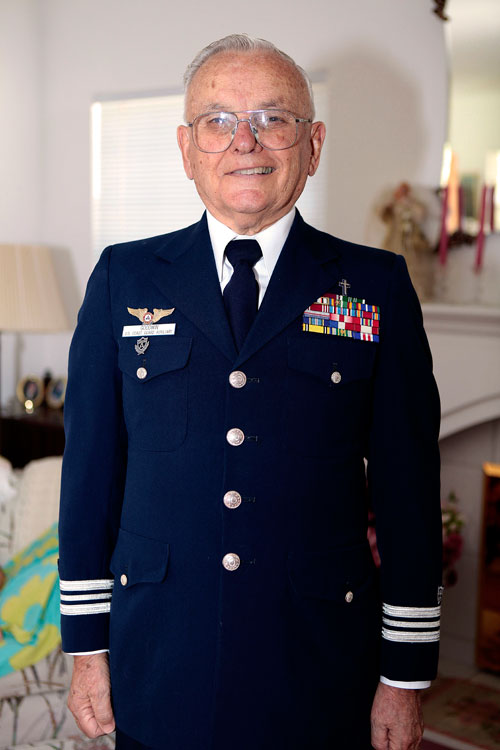
Leslie Goodwin in 2013
These miracles, which I have experienced firsthand, have had a tremendous effect on my life. I have seen the hand of God鈥檚 protection, and for that I am forever grateful.
I have also thoroughly enjoyed my service in the Merchant Marine and the Coast Guard Auxiliary. The uniform I wear today stands for 52 years of service. I no longer go out on patrol, but I do enjoy speaking at schools, emphasizing to students the fact that the military is not only about taking lives. I have seen some students鈥� lives altered when they learn that they can join a branch of the service and actually save lives.
Norman passed away in June of 2013. I said the opening prayer of his service and also read a text from the Bible. I look forward to seeing my twin brother some day when we are both in Heaven together.
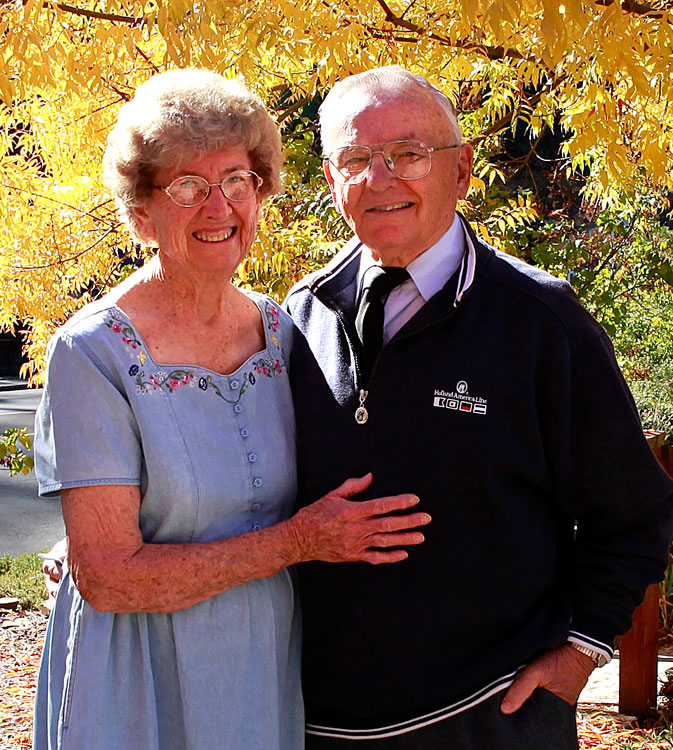
Virginia and Leslie in 2013


